Why Digital Identity Is Still Hard
A First Look at Identity in Banking
I've been turning over how many banking processes start the same way. Someone needs to prove they are who they say they are. Account opening, wire transfers, loan applications, address changes. Every single one begins with identity.
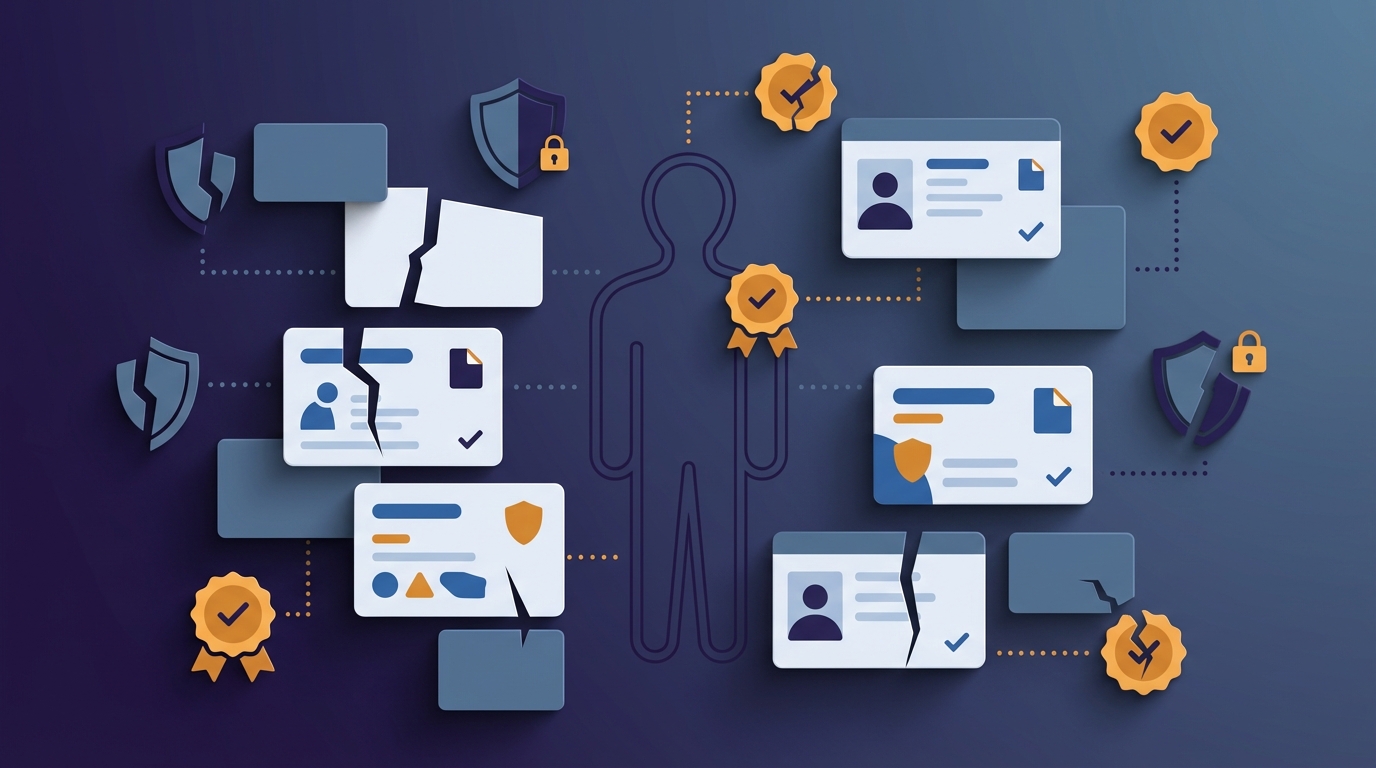
And every single one of those moments carries friction. The friction is not accidental. It's structural.
No Universal Answer
The United States does not have a universal digital identity system. There is no single credential that says "this is me" in a way that every institution accepts. Other countries have national ID systems. Estonia has e-Residency. India has Aadhaar. The US has a patchwork.
What we have instead is a combination of documents. A driver's license from one of fifty states. A Social Security number that was never designed to be an identifier. A passport that most people don't carry daily. A utility bill to prove an address. Put them together and you get something close to identity, but it's duct tape, not architecture.
The Social Security number is the part that still gets me. It was created in 1936 to track earnings for Social Security benefits. That's it. It was never intended as a universal ID. The original cards even said "not for identification." But over decades it became the de facto identifier because nothing better existed. Now it's the linchpin of a system it was never built to support, and it leaks constantly.
Where It Shows Up
In banking, identity verification is not optional. KYC requirements exist because of the Bank Secrecy Act and anti-money laundering regulations. Before a bank can open an account, it needs to verify the client's name, date of birth, address, and identification number. That sounds simple, but the execution is anything but.
The documents are physical. The verification is often manual. The data sources are fragmented across credit bureaus, government databases, and third-party providers. And the stakes are real. Get it wrong in one direction and you let a bad actor in. Get it wrong in the other direction and you turn away a legitimate client who just wants a checking account.
What strikes me is how this creates a cascade of downstream problems. Fraud prevention depends on identity. Credit decisions depend on identity. Even something as simple as resetting online banking access loops back to the same question. Every process inherits whatever weakness exists in that first identity check.
How Verification Works
The thing I came to understand is that no single check holds up on its own, so the whole approach has gone layered. Knowledge-based authentication, the security questions only the real person should know, stopped convincing me once I saw how many of those answers sit in breach data. Document verification scans an ID against templates, but it is only as good as the forgery it faces. Biometric verification matches a selfie to the ID photo, and device intelligence reads signals from the phone or computer in use. Each one is beatable on its own, which is exactly why banks stack them.
Each layer adds confidence, but each layer also adds friction, and that's where it gets uncomfortable for me. For a community bank, the question that nags at me is which layers are worth the cost and the complexity. The big banks and fintechs can build or buy sophisticated identity stacks. A community bank has to be more deliberate about what it can support and maintain.
Why It Matters
The deeper point is that identity is not just a compliance checkbox. It's the foundation that everything else sits on. If the identity layer is weak, then fraud prevention is harder, client experience suffers, and the bank carries risk it can't see clearly.
The fact that this problem remains unsolved at a national level is striking. We can process payments in seconds. We can run machine learning models on transaction data. But we still can't answer the basic question of "who is this person?" without asking them to upload a photo of their driver's license.
That gap is where a lot of the real work in banking is. Not the flashiest problem, but one that touches everything else.